
SDG 13 – Indicator 13.3.1 Local education programmes on climate
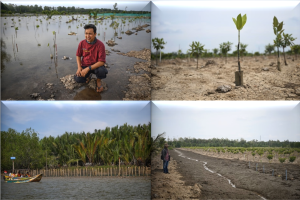
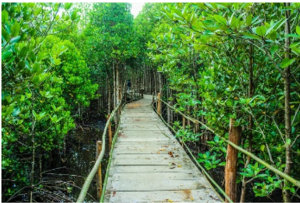
Beyond campus boundaries, UNSRI is actively engaged in Local Education Programmes on Climate, particularly through mangrove planting initiatives in Sungsang, Banyuasin. These efforts have received wide support, as mangroves play a vital role in maintaining Climate change by its sequestering carbon. Reports such as “Shoots of Hope” and studies highlighting the critical growth phase of mangroves emphasize the importance of long-term care and monitoring of planted seedlings. The planting of thousands of mangroves in the TAA Port area further demonstrates the commitment of students and communities in safeguarding coastal ecotourism.
In addition to planting, UNSRI and its partners also conduct local education and awareness programmes on climate change impacts, mitigation, and coastal adaptation. These activities aim to strengthen community knowledge and resilience to climate risks, impacts, mitigation, adaptation, impact reduction and early warning.
Link: http://str.sg/viz-mangroves
SDG 13 – Indicator 13.3.2 Climate Action Plan, shared
Through SMART Program (Collaboration between UNSRI, CIFOR, TEMASEK, local government and local community groups) plan to to absorb 180 tons of carbon dioxide after 2025, with a focus on improving the survival rate of planted mangrove seedlings. In 2024, this program has successfully absorbed 67.16 tons of carbon dioxide. Community involvement in planting, caring for, and monitoring mangrove seedlings through an Android-based application has shown positive results, with an average seedling survival rate of 50% after two years of planting.
In addition to ecological aspects, this program also focuses on local economic empowerment through the development of ecotourism and silvofishery-based businesses. Local community groups manage mangrove nurseries and mangrove crab ponds, which not only increase their income but also strengthen their socio-economic resilience in the face of climate change impacts.
Link:
SDG 13 – Indicator 13.3.3 Co-operative planning for climate change disasters
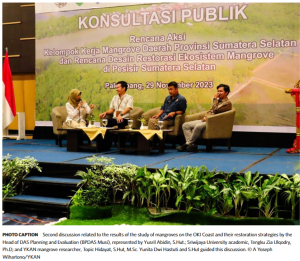
The Mangrove Ecosystem Restoration Alliance (MERA) Program, facilitated by the Yayasan Konservasi Alam Nusantara (YKAN), is actively supporting mangrove ecosystem rehabilitation and restoration efforts in South Sumatra, Indonesia. These crucial efforts are being spearheaded by the South Sumatra Provincial Forestry Service and the Watershed Management Agency (BPDAS) Musi.
A key component of the MERA Program is the development of a comprehensive Ecosystem Restoration Plan Document specifically tailored for South Sumatra, with a primary focus on the coastal region of Ogan Komering Ilir Regency (OKI). Sriwijaya University (UNSRI) and YKAN initiated the drafting of this plan before 2023.
To ensure a holistic and well-informed approach to restoration, the plan’s development involved extensive and comprehensive field studies conducted along the OKI Coast. These studies encompassed a range of crucial analyses, including:
- Ecological analysis: Assessing the current state of the mangrove ecosystem, identifying key threats and challenges, and mapping areas for restoration.
- Social analysis: Understanding the social dynamics, community dependence on mangroves, and potential impacts of restoration on local communities.
- Economic analysis: Evaluating the economic benefits of mangrove restoration, including fisheries, coastal protection, and tourism potential.
Link:
SDG 13 – Indicator 13.3.4 Inform and support government
Sriwijaya University (UNSRI) recently celebrated its 63rd anniversary. As part of the celebrations, the Faculty of Economics organized a scientific discussion focused on using resources to achieve Sustainable Development Goals (SDGs) in rural areas. This event was held on November 6, 2023, at the Magister Manajemen UNSRI Auditorium on the Bukit Besar Palembang Campus.
The main objective of the discussion was to explore how existing resources in villages can be utilized effectively. This aligns with the Village SDGs initiative, which has 18 key programs aimed at improving rural communities. These programs include goals like eliminating poverty and hunger in villages.
Prof. Dr. Paiman Raharjo, the Deputy Minister of Villages of the Republic of Indonesia, expressed his hope that the event would raise awareness about sustainable development and its importance for communities. He emphasized the need to align these efforts with the “Nawa Cita,” the nine national priorities set by the Indonesian President.
Prof. Raharjo highlighted that one of the key priorities of the Nawa Cita is to develop communities from the ground up, starting with rural areas. Villages are a central focus in the government’s efforts to reduce poverty, leading to significant funding allocations for poverty eradication programs in these areas.
Link:
SDG 13 – Indicator 13.3.5 Environmental education collaborate with NGO
The Hutan Kita Institute (HaKi) in Palembang, Indonesia, focuses on sustainable forest ecosystems. Prof. Rujito, Chair of the Social Forestry Acceleration Working Group, recommends several strategies to address challenges in Social Forestry in South Sumatra. These include broader stakeholder engagement, resolving land conflicts, strengthening institutions of permit holders, supporting business development, ensuring financial obligations are met, facilitating conservation initiatives, and promoting educational and research activities related to Social Forestry. His recommendations aim to improve the management and sustainability of Social Forestry for the benefit of both the environment and local communities.
Links:
- https://hutaninstitute.or.id/tantangan-dan-rekomendasi-perhutanan-sosial-di-sumatera-selatan/
- https://www.cifor-icraf.org/news/corporate-news/universitas-sriwijaya-and-cifor-icraf-to-continue-working-together-on-landscape-restoration-and-other-critical-issues/?utm_source=site-search&utm_medium=cifor-icraf-website&utm_campaign=traffic-source
A renewed formal collaboration between the university and the Center for International Forestry Research and World Agroforestry (CIFOR-ICRAF) will stimulate research into ways to effectively and efficiently restore landscapes and address other critical issues.
Universitas Sriwijaya is based in Palembang, in Indonesia’s South Sumatra Province, which has hundreds of thousands of hectares of degraded peatland. The renewed research agreement contributes to the global community’s effort to intensify restoration of the world’s degraded land through mechanisms such as the Land Degradation Neutrality framework of the United Nations Convention to Combat Desertification and the Bonn Challenge. The agreement also contributes specifically to the Government of Indonesia’s efforts to restore an estimated 12 million hectares of degraded land by 2030, of which 2 million is degraded peatland. Research into site-specific techniques, especially in populated landscapes, is crucial for ensuring the success of such programmes; many restoration projects have failed by not fully understanding their landscape and the people in it.
Achieving this ambition in a mere seven years will require all stakeholders to work together in a coordinated manner, with appropriate funding, monitoring and adjustments. The two organizations are keen to assist the government achieve its goals through applied research into new restoration methods – particularly those suited to degraded peatland – and ways of increasing the scale of successful methods efficiently and effectively.
The collaboration document, in the form of a memorandum of understanding (MoU), was signed by the Rector of Universitas Sriwijaya Anis Saggaff and CIFOR-ICRAF’s Chief Operating Officer Robert Nasi at the university’s campus in Palembang on 21 August 2023.